
10 Plants That Propagate Easily
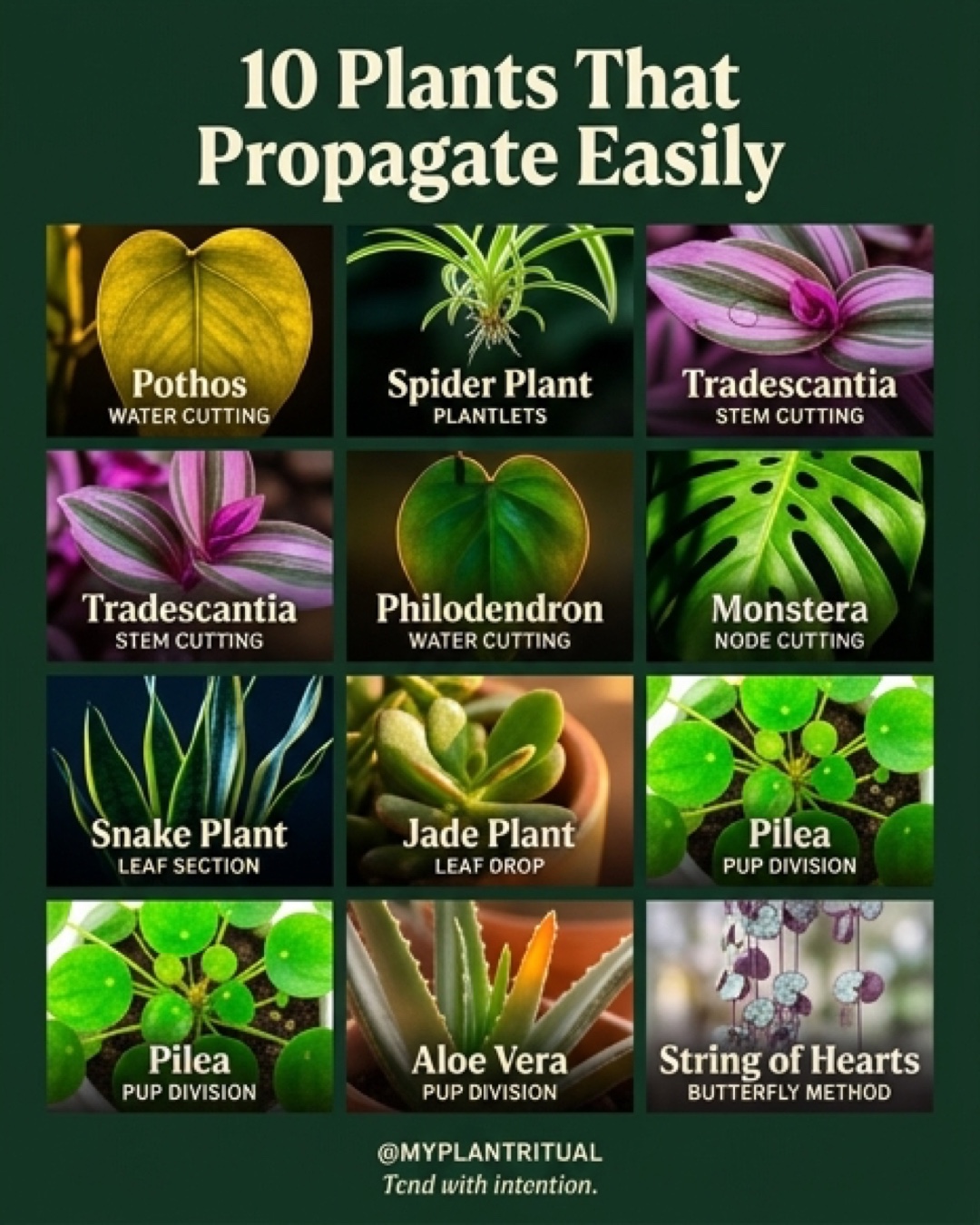
Buying new plants is fun, but growing them for free? Even better. Propagation is one of the most rewarding parts of plant care — you take a cutting or a pup from a plant you already love, and a few weeks later, you've got a whole new one. Spring is the ideal time to start, since longer days and warmer temperatures encourage faster root growth.
Here are ten plants that make propagation genuinely easy, even if you've never tried it before.
1. Pothos (Epipremnum aureum)
Pothos is the gold standard of easy propagation. Snip a stem just below a node — that little bump where a leaf meets the stem — and drop it in a glass of water. You'll usually see roots within a week, sometimes sooner. Once the roots are a couple of inches long, pot it up in soil and you're done.
- Method: Water propagation from stem cuttings
- Difficulty: Absolute beginner
- Time to root: 5–10 days
2. Spider Plant (Chlorophytum comosum)
Spider plants do most of the work for you. Those dangling babies (called plantlets) hanging from the mother plant are already partially rooted. You can snip one off and place it directly in soil or water. It barely even counts as propagation — the plant has basically propagated itself.
- Method: Separate plantlets from stolons
- Difficulty: Effortless
- Time to root: 1–2 weeks (or already rooted)
3. Tradescantia (Tradescantia zebrina)
Tradescantia roots faster than almost any houseplant. Take a stem cutting a few inches long, remove the bottom leaves, and stick it in water or straight into moist soil. Roots appear within days, sometimes overnight. This is the plant to start with if you want instant gratification.
- Method: Stem cuttings in water or soil
- Difficulty: Absolute beginner
- Time to root: 3–7 days
4. Heartleaf Philodendron (Philodendron hederaceum)
This trailing beauty propagates just as easily as Pothos. Cut a stem below a node, place it in water, and wait. The roots come quickly and reliably. There's no real trick to it — Heartleaf Philodendron is one of those plants that simply wants to grow.
- Method: Water propagation from stem cuttings
- Difficulty: Absolute beginner
- Time to root: 7–14 days
5. Monstera (Monstera deliciosa)
Monstera propagation feels like a bigger deal because the plant itself is so impressive, but it's actually straightforward. Take a cutting with at least one node and one aerial root if possible. Place it in water or wrap the node in damp sphagnum moss. Be a little more patient here — Monstera takes longer than a Pothos — but the success rate is high.
- Method: Single node cutting in water or sphagnum moss
- Difficulty: Beginner to intermediate
- Time to root: 2–4 weeks
6. Snake Plant (Sansevieria trifasciata)
Snake plant propagation requires patience, but very little skill. Cut a healthy leaf into sections a few inches long, let the cuts callous for a day, and place them upright in soil. They root slowly — we're talking weeks to months — but they're almost impossible to fail. Just don't overwater.
- Method: Leaf cuttings in soil
- Difficulty: Easy (just slow)
- Time to root: 4–8 weeks
7. Jade Plant (Crassula ovata)
Jade plants are wonderfully cooperative. A single fallen leaf can become a new plant. Place the leaf on top of dry soil, and within a few weeks tiny roots and a miniature rosette will appear at the base. You can also take stem cuttings for faster results. Let any cuttings dry for a day or two before planting.
- Method: Leaf or stem cuttings on soil
- Difficulty: Easy
- Time to root: 2–4 weeks
8. Pilea (Pilea peperomioides)
Pilea practically propagates itself. Mature plants send up pups — small offsets — around the base of the mother plant. Once a pup has a few leaves and some of its own roots, you can gently separate it and pot it up on its own. It's one of the most satisfying propagation experiences because the baby plant is already established.
- Method: Separate root pups
- Difficulty: Effortless
- Time to root: Already rooted when separated
9. Aloe Vera (Aloe barbadensis)
Like Pilea, Aloe Vera produces offsets (pups) at the base of the parent plant. Wait until the pup is a few inches tall, then carefully remove it with some roots attached. Pot it in well-draining soil and give it a week to settle before watering. Once established, it grows quickly.
- Method: Separate root pups
- Difficulty: Easy
- Time to root: Already rooted when separated
10. String of Hearts (Ceropegia woodii)
String of Hearts gives you options. The butterfly method — laying a section of vine on moist soil with the nodes pressed down — is a popular way to fill out a pot quickly. You can also take stem cuttings and root them in water. Either way, this delicate-looking plant is surprisingly willing to multiply.
- Method: Butterfly method or stem cuttings
- Difficulty: Beginner
- Time to root: 2–3 weeks
Tips for Success
Propagation doesn't require much, but a few basics make a real difference.
- Make clean cuts. Use sharp scissors or pruning shears. A clean cut heals faster and reduces the risk of rot.
- Use warm, not cold water. Room temperature water encourages root growth. Cold water can shock fresh cuttings and slow things down.
- Keep cuttings in bright, indirect light. Direct sun is too intense for rootless cuttings. A spot near a window with filtered light is ideal.
- Be patient. Some plants root in days, others take weeks. Resist the urge to check or disturb cuttings too often — roots grow best when left alone.